
Buddha Bugs
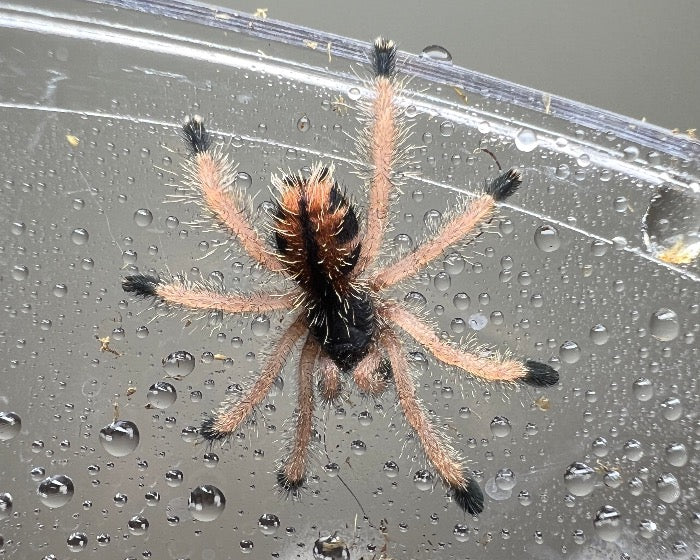
Avicularia avicularia morphotype 1 (common pink-toed tarantula) 1"
Avicularia avicularia morphotype 1 (common pink-toed tarantula) 1"
Before ordering: Unless marked “exact animal pictured,” photos are representative; refer to the product title or selected option for the size or sex offered. Shipped live-animal orders require a $50 cart subtotal and are normally held for pickup at an authorized FedEx Ship Center. Please review our Shipping & Live Arrival and Refund & Cancellation policies before purchasing.
Couldn't load pickup availability
Species Overview
Avicularia avicularia morphotype 1 (M1), commonly known as the common pinktoe tarantula or Guyana pinktoe tarantula, is a medium-sized arboreal tarantula from northern South America and Trinidad and Tobago. Adult females are dark brown to nearly black, with fine silvery-gray to olive-green carapace setae accentuating the radiating grooves. The legs and pedipalps display variable green to blue-green iridescence, especially on the femora, while the distal segments often appear darker. Pink to salmon-colored toe tips and narrow whitish rings at several joints provide contrast.
The abdomen has a broad, velvety black central and posterior field, with long rusty-red to rose-red guard setae concentrated anteriorly and laterally. These hairs may show a pink sheen. Scattered white-tipped guard setae may occur across the legs and pedipalps but can be inconspicuous. Red guard setae also occur on the legs, particularly the third and fourth pairs. They are most noticeable along the tibiae and metatarsi of the fourth pair. The intensity and apparent hue of the iridescence vary with lighting and viewing angle. Mature males are slimmer and have proportionally longer legs than females, with dark brownish guard setae rather than red.
Spiderlings have a nearly black carapace and pale peach to reddish-brown legs ending in sharply contrasting black tarsi. The abdomen ranges from orange-red to reddish-brown and bears a broad black median stripe with dark transverse markings along the sides. Long whitish setae project from the legs and abdomen. As they grow, the legs darken and develop pink toe tips, while the contrasting abdominal pattern gradually fades.
In captivity, A. avicularia constructs elevated silk retreats among cork bark, branches, foliage, and enclosure walls. Established individuals may remain visible near the retreat entrance, particularly after dark, although some spend much of their time concealed. They are often calm when undisturbed but can move quickly or jump when startled, and disturbed specimens may spray feces toward a perceived threat. The abdomen bears type II urticating hairs, which are transferred primarily through direct contact.
- Common Name: Common pinktoe tarantula; Guyana pinktoe tarantula
- Native Range: Brazil, Guyana, French Guiana, Venezuela, and Trinidad and Tobago (reported distribution of morphotype 1)
- Life Habit: Arboreal
- Adult Size: Approximately 4.5–6 inches in diagonal leg span
- Lifespan: Males 3–4 years; females 10–12+ years under optimal captive conditions
- Temperament: Generally calm when undisturbed; may move quickly or jump when startled
- Care Difficulty: Easy to Moderate
Avicularia avicularia M1 Care
Avicularia avicularia morphotype 1 adapts well to captivity when provided with a vertically oriented enclosure, proper ventilation, accessible drinking water, and secure elevated retreat sites. Cork bark and foliage should extend into the upper enclosure to provide climbing surfaces and web anchors. Arrange these so routine feeding and watering cause minimal disturbance to the retreat.
- Enclosure: 25-dram vial or equivalent for spiderlings, upgraded as needed with growth; 8” x 8” x 12” or larger for adults
- Substrate: Coconut fiber, peat moss, or other moisture-retentive substrate
- Temperature: 72–82°F
- Humidity: Moderate humidity with proper ventilation is generally sufficient. Maintain a moisture gradient by keeping approximately 25–50% of the substrate slightly moist and the remainder drier, adjusting water additions to the enclosure’s drying rate. Avoid saturated substrate, persistent condensation, and stagnant air.
- Diet: Fruit flies, crickets, cockroaches, and other appropriately sized feeder insects
- Feeding: Spiderlings can be offered appropriately sized prey once or twice weekly. Juveniles and adults are typically fed every 7–14 days, with feeding frequency adjusted based on prey size, growth rate, and the condition of the individual animal.
- Water: Lightly moisten part of the substrate as needed and provide water droplets on the walls for spiderlings; larger specimens should have access to a water dish.
- Routine Maintenance: Remove uneaten prey, monitor moisture levels, and spot-clean when necessary.
Natural History
Avicularia avicularia was described by Linnaeus in 1758 and is the type species of Avicularia. The species as currently recognized has a broad distribution that includes northern South America, parts of Peru and Bolivia, and Trinidad and Tobago.
In 2017, Caroline Fukushima and Rogério Bertani conducted a major taxonomic revision of the genus Avicularia. The revision placed several previously recognized species names in synonymy and distinguished seven morphotypes within A. avicularia. These are informal color-pattern groupings without separate species or subspecies status. Morphotype 1 spans multiple countries and does not identify a single locality. The authors left open the possibility that further research could reveal cryptic species within A. avicularia.
Misidentification and inconsistent hobby labeling have led to unintended hybridization between Avicularia species and the mixing of morphotypes and locality lines within A. avicularia. Morphotype 1 describes a color-pattern grouping across a broad geographic range; the designation alone does not establish a specimen’s locality or breeding history. The absence of a locality label is not, by itself, evidence of hybridization. Breeding stock should be reliably identified, with all available source and parentage information retained. Specimens without reliable locality information should not be introduced into documented locality lines solely because they share the M1 designation.
Stradling’s 1994 field study of Avicularia avicularia in an abandoned tonka bean plantation in Trinidad documented juveniles living between the leaves of low-growing plants. Larger immatures and adult females generally constructed camouflaged silk retreats on tree trunks, commonly 1.5–3 meters above ground. Activity was closely associated with changes in light at dusk and dawn.
These observations provide species-level natural-history context. The study predates the numbered morphotype system, and morphotypes 1 and 6 have both been reported from Trinidad and Tobago. Its findings should therefore not be attributed specifically to M1 without additional evidence.
Shipping
Shipping
Shipping method for live animal orders:
Orders containing live animals must have a subtotal of at least $50 to qualify for shipping.
For orders containing live animals, we ship throughout the continental U.S. (48 states) via FedEx Priority Overnight. Orders containing both live and non-live products may be shipped together or separately, depending on the items in the order, their sizes, and whether everything can fit safely in one shipment. When non-live products must be shipped separately by USPS, additional shipping charges will apply.
Live-animal packages are normally dropped off on Tuesdays or Wednesdays for next-day arrival. By default, packages are held for pickup at the nearest reasonably accessible FedEx Ship Center authorized to accept the shipment and must be collected in person.
Home delivery is available upon request. When a reasonably accessible authorized FedEx Ship Center is available, customer-requested home delivery is not eligible for our live arrival guarantee and is sent at the customer’s risk.
FedEx Ship Center availability varies by destination, and not every FedEx location is authorized to accept live-animal shipments. If no reasonably accessible authorized FedEx Ship Center is available, we will contact the customer and arrange home delivery. In this circumstance, home delivery remains eligible for LAG, provided all other LAG requirements are met.
Checkout shipping rates and free-shipping offers are based on FedEx Ship Center pickup. Any additional amount charged for home delivery is the customer’s responsibility and must be paid before shipment. For qualifying orders, free shipping covers standard Ship Center service but not any additional home-delivery cost. If no reasonably accessible authorized Ship Center is available and the customer declines the additional charge, the affected portion of the order—or the entire order when necessary—may be canceled without the standard cancellation fee.
We also offer expo pickup and a DFW local-meetup option. Please see our Expo Schedule for additional information.
Shipping method for non-live orders:
For shipments containing no live animals, shipping is available to all 50 states via USPS Ground Advantage or USPS Priority Mail. We will ship non-live orders directly to the address listed on the order, typically the day the order is placed or the following day.
What to expect after placing an order:
If your order contains live animals that will be shipped, we will contact you within 12 hours with a proposed delivery date and, when applicable, the FedEx Ship Center pickup location. If home delivery is requested or required, we will provide the delivery arrangements and any additional shipping charge. We will not ship the package until you confirm the arrangements and any outstanding shipping balance has been paid. Tracking information will be provided on the day of shipment.
Shipping may be delayed because of weather, carrier conditions, our schedule, or if an animal has recently molted or appears likely to molt. We will notify you if a delay is necessary and arrange another suitable date.
Carrier delays can occur. Customers remain responsible for meeting the applicable pickup or receipt requirements on the day the package actually arrives, even if it arrives later than originally scheduled.
Live Arrival Guarantee (LAG):
Buddha Bugs offers a live arrival guarantee only when all of the following conditions are met:
- Freebies are not covered by LAG.
- When a reasonably accessible FedEx Ship Center authorized to accept the shipment is available, the package must be held for pickup at that location.
- If no such location is available, we will arrange home delivery. In this circumstance, home delivery remains eligible for LAG, provided all other requirements are met.
- Packages held at a FedEx Ship Center must be picked up on the day they arrive. Pickup at any time during the location’s regular opening hours is acceptable. Please bring valid identification.
- In the unlikely event of a DOA, the customer must contact us and provide clear photographic or video evidence within three hours of FedEx Ship Center pickup—or within three hours of delivery when an LAG-eligible home delivery applies.
- Shipping costs are not refunded, and replacements may not always be available.
ANY DEVIATION FROM THESE REQUIREMENTS MAY VOID THE LAG.
Home delivery is available upon request. When a reasonably accessible FedEx Ship Center authorized to accept the shipment is available, customer-requested home delivery is not eligible for LAG and is sent at the customer’s risk. When no such location is available, home delivery arranged by Buddha Bugs is eligible for LAG, provided all other requirements are met.
For animal safety, we do not ship live animals for home delivery when temperatures are 90°F or higher or 35°F or lower, regardless of whether the shipment would otherwise qualify for LAG.
FedEx does not reimburse Buddha Bugs for lost packages or the loss of live animals. We take every reasonable precaution to give each shipment the best chance of arriving safely.
Returns & Refunds
Returns & Refunds
Returns & Refunds:
We DO NOT accept returns on live animals.
You may return non-live animal products for a refund within 14 days of delivery. The product must be unused and in its original packaging. After we receive your return, we will process refunds within 5-10 business days. Refunds will not include shipping costs. We will reject used products and, when possible, ship them back to the customer.
If an animal arrives deceased, contact us within the required three-hour period and provide clear photographic or video evidence. When all live arrival guarantee requirements are met, we will provide the applicable refund or arrange a replacement when available. Multi-count products are handled according to the number of live animals received. Shipping costs and freebies are not covered. Please review our Shipping & Live Arrival Policy for complete requirements.
For online purchases with local pickup, pickup at a show, or for purchases made at a show, the customer is responsible for inspecting the purchased items and verifying that they are to their satisfaction. If they are not, they must express any dissatisfaction before the sale is completed, as all sales are final. We are not liable for damages after the customer receives their items due to issues including but not limited to the customer mishandling transport and/or overheating animals.
Cancellations:
Customer-requested cancellations are subject to an approximately 3% cancellation fee. For card payments, the fee is 2.9% + $0.30 per transaction; different payment methods may have slightly higher or lower fee amounts. This reflects the nonrecoverable payment-processing cost charged when the order is placed and not returned to us when a refund is issued. Canceling an order also creates additional labor and temporarily removes inventory from availability, so please make sure you are committed before placing an order.
If a product is unavailable because of an inventory error, we will contact the customer and offer to cancel the affected product or the complete order without a cancellation fee.
If we determine after an order is placed that no reasonably accessible FedEx Ship Center authorized to accept the shipment is available, we will contact the customer with any additional cost required for home delivery. If the customer declines that additional charge, the affected portion of the order—or the entire order when necessary—may be canceled without the standard cancellation fee.
Certain ESA-listed Poecilotheria species cannot be shipped across state lines and are clearly marked “TX SALES ONLY” in their product titles and descriptions. If a customer outside Texas purchases one of these animals, the restricted portion of the order—or the entire order when necessary—will be canceled. The approximately 3% cancellation fee will be deducted from the refund because the restriction was disclosed before purchase. Refunds will be issued to the original payment method, but the time required for the credit to appear depends on the payment provider.
Share
