


Buddha Bugs
Davus sp. 'Panama' (Panama pink tarantula) 0.5"
Davus sp. 'Panama' (Panama pink tarantula) 0.5"
Before ordering: Unless marked “exact animal pictured,” photos are representative; refer to the product title or selected option for the size or sex offered. Shipped live-animal orders require a $50 cart subtotal and are normally held for pickup at an authorized FedEx Ship Center. Please review our Shipping & Live Arrival and Refund & Cancellation policies before purchasing.
Couldn't load pickup availability
Species Overview
Davus sp. ‘Panama’ is a small, undescribed terrestrial burrowing tarantula from Panama, referred to here as the Panama pink tarantula and also known within the hobby as the lava tarantula or lava spider. It was previously circulated as Theraphosinae sp. ‘Panama’.
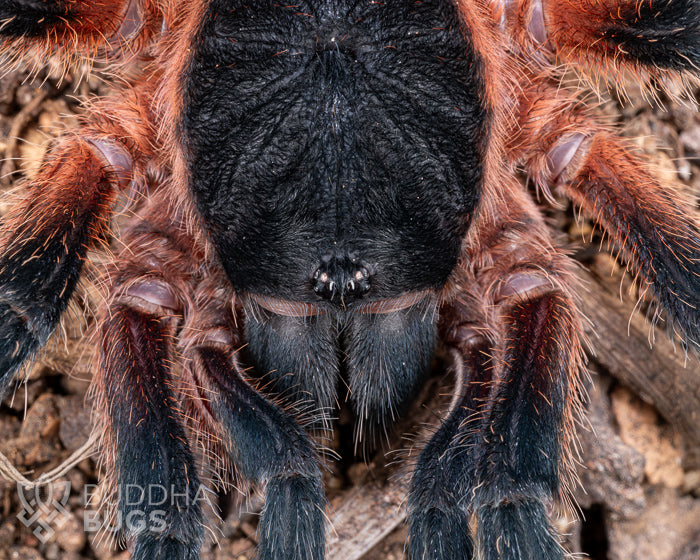
Mature females have a compact, robust build and a broad carapace covered with short, velvety black setae. Dense salmon-red to coppery-orange setae cover the coxae, trochanters, and much of the femora, contrasting with the dark patellae and remaining leg segments.
Long red-orange setae are concentrated along the sides and rear of the black abdomen, leaving a broad dark median field and several dark transverse bands. Freshly molted specimens display the strongest contrast, while the red-orange coloration may fade toward rust or reddish brown later in the molt cycle. Mature males are slimmer and have proportionally longer legs but retain the same general pattern.
Young spiderlings have translucent pale pink to salmon-colored legs, a dark gray to black carapace, and a smoky gray or brown abdomen covered with fine pinkish setae. Their legs progressively darken as they grow, while the reddish setae become denser and more saturated.
In captivity, Davus sp. ‘Panama’ grows at a moderate-to-fast pace and readily excavates beneath cork bark or enlarges a provided starter retreat. Individuals frequently line their retreats and surrounding substrate with silk, and established juveniles and adults may remain visible near the entrance when not in premolt. When disturbed, they generally retreat or draw their legs tightly over the body, although they can move quickly and may use urticating hairs defensively.
- Common Name: Panama pink tarantula, lava tarantula, lava spider
- Native Range: Panama; precise locality and geographic extent remain unpublished
- Life Habit: Terrestrial opportunistic burrower
- Adult Size: 3.5–4.5 inches in diagonal leg span
- Lifespan: Males approximately 2–4 years; females commonly estimated at 8–12+ years under optimal conditions, although species-specific longevity records remain limited
- Temperament: Generally reclusive and prone to retreat; capable of rapid movement when disturbed
- Care Difficulty: Moderate; small spiderlings require attentive moisture management
Davus sp. ‘Panama’ Care
Davus sp. ‘Panama’ adapts well to captivity when provided with a secure enclosure, adequate substrate for burrowing, moderate moisture, and proper ventilation. The small size of spiderlings requires particular attention to both hydration and containment. Their substrate should not be allowed to become completely dry, but persistently saturated conditions, condensation, and stagnant air should also be avoided. Once established and past the smallest spiderling stages, this species becomes considerably more tolerant of minor environmental variations.
- Enclosure: 1 oz condiment cup or equivalent for spiderlings, upgraded as needed with growth; 9” x 7” x 6” or larger terrestrial enclosure for adults.
- Substrate: Coconut fiber, peat moss, topsoil, or a similar moisture-retentive substrate with sufficient depth to permit burrowing. Provide a partially buried piece of cork bark or similar enclosure décor as a starter retreat.
- Temperature: 72–82°F.
- Humidity: Keep approximately 50% of the substrate moist while allowing the remainder to remain drier. For very small spiderlings, prevent the lower substrate layers from drying completely. Maintain good ventilation and avoid saturated substrate, standing water, or persistent condensation.
- Diet: Fruit flies, crickets, cockroaches, and other appropriately sized feeder insects.
- Feeding: Spiderlings can be offered appropriately sized prey once or twice weekly. Juveniles and adults are typically fed every 7–14 days, with feeding frequency adjusted according to prey size, growth rate, and the condition of the individual animal.
- Water: Provide droplets on the enclosure wall, cork bark, or webbing for small spiderlings. Provide a water dish once the spider is large enough to use one safely. Lightly moisten the designated portion of substrate as needed without saturating the entire setup.
- Routine Maintenance: Remove uneaten prey, monitor moisture levels, and spot-clean when necessary.
Natural History
The genus Davus was established in 1892 for Davus fasciatus. It was later placed in synonymy with Cyclosternum before being restored and redefined.
Of the described species, D. fasciatus is recorded from Costa Rica and Panama, while D. santos is known only from Panama. The morphology of D. fasciatus excludes it as an identity for the hobby animal, leaving the superficially similar D. santos as the only plausible described candidate. By the time D. santos was described in 2016, the hobby animal was already circulating as Theraphosinae sp. ‘Panama’. D. santos remained poorly known within the hobby, and the earlier designation persisted without a confirmed generic or specific identification.
In 2022, members of the Theraphosid Research Team, including Volker von Wirth, examined preserved males and females from two Panamanian localities. The lateral abdominal pattern, single central spermathecal receptaculum, apical keel on the male palpal bulb, and presence of type III urticating setae supported placement in Davus. Comparison of the reproductive structures with those of D. santos demonstrated that the two were not conspecific. The provisional designation Davus sp. ‘Panama’ was therefore proposed for the hobby animal.
In 2025, without knowledge of that earlier conclusion, we independently examined the palpal bulbs of a mature male from the captive hobby population. They likewise did not match those of D. santos, corroborating the conclusion that Davus sp. ‘Panama’ represents a distinct, undescribed species.
Its native distribution cannot presently be stated more precisely than Panama, and its habitat and ecology remain undocumented in published field studies. Ecological observations of D. santos should not be applied to this species merely because the two resemble one another or may occur nearby. Captive observations demonstrate burrowing and substantial silk use, but corresponding observations from the wild are lacking.
Shipping
Shipping
Shipping method for live animal orders:
Orders containing live animals must have a subtotal of at least $50 to qualify for shipping.
For orders containing live animals, we ship throughout the continental U.S. (48 states) via FedEx Priority Overnight. Orders containing both live and non-live products may be shipped together or separately, depending on the items in the order, their sizes, and whether everything can fit safely in one shipment. When non-live products must be shipped separately by USPS, additional shipping charges will apply.
Live-animal packages are normally dropped off on Tuesdays or Wednesdays for next-day arrival. By default, packages are held for pickup at the nearest reasonably accessible FedEx Ship Center authorized to accept the shipment and must be collected in person.
Home delivery is available upon request. When a reasonably accessible authorized FedEx Ship Center is available, customer-requested home delivery is not eligible for our live arrival guarantee and is sent at the customer’s risk.
FedEx Ship Center availability varies by destination, and not every FedEx location is authorized to accept live-animal shipments. If no reasonably accessible authorized FedEx Ship Center is available, we will contact the customer and arrange home delivery. In this circumstance, home delivery remains eligible for LAG, provided all other LAG requirements are met.
Checkout shipping rates and free-shipping offers are based on FedEx Ship Center pickup. Any additional amount charged for home delivery is the customer’s responsibility and must be paid before shipment. For qualifying orders, free shipping covers standard Ship Center service but not any additional home-delivery cost. If no reasonably accessible authorized Ship Center is available and the customer declines the additional charge, the affected portion of the order—or the entire order when necessary—may be canceled without the standard cancellation fee.
We also offer expo pickup and a DFW local-meetup option. Please see our Expo Schedule for additional information.
Shipping method for non-live orders:
For shipments containing no live animals, shipping is available to all 50 states via USPS Ground Advantage or USPS Priority Mail. We will ship non-live orders directly to the address listed on the order, typically the day the order is placed or the following day.
What to expect after placing an order:
If your order contains live animals that will be shipped, we will contact you within 12 hours with a proposed delivery date and, when applicable, the FedEx Ship Center pickup location. If home delivery is requested or required, we will provide the delivery arrangements and any additional shipping charge. We will not ship the package until you confirm the arrangements and any outstanding shipping balance has been paid. Tracking information will be provided on the day of shipment.
Shipping may be delayed because of weather, carrier conditions, our schedule, or if an animal has recently molted or appears likely to molt. We will notify you if a delay is necessary and arrange another suitable date.
Carrier delays can occur. Customers remain responsible for meeting the applicable pickup or receipt requirements on the day the package actually arrives, even if it arrives later than originally scheduled.
Live Arrival Guarantee (LAG):
Buddha Bugs offers a live arrival guarantee only when all of the following conditions are met:
- Freebies are not covered by LAG.
- When a reasonably accessible FedEx Ship Center authorized to accept the shipment is available, the package must be held for pickup at that location.
- If no such location is available, we will arrange home delivery. In this circumstance, home delivery remains eligible for LAG, provided all other requirements are met.
- Packages held at a FedEx Ship Center must be picked up on the day they arrive. Pickup at any time during the location’s regular opening hours is acceptable. Please bring valid identification.
- In the unlikely event of a DOA, the customer must contact us and provide clear photographic or video evidence within three hours of FedEx Ship Center pickup—or within three hours of delivery when an LAG-eligible home delivery applies.
- Shipping costs are not refunded, and replacements may not always be available.
ANY DEVIATION FROM THESE REQUIREMENTS MAY VOID THE LAG.
Home delivery is available upon request. When a reasonably accessible FedEx Ship Center authorized to accept the shipment is available, customer-requested home delivery is not eligible for LAG and is sent at the customer’s risk. When no such location is available, home delivery arranged by Buddha Bugs is eligible for LAG, provided all other requirements are met.
For animal safety, we do not ship live animals for home delivery when temperatures are 90°F or higher or 35°F or lower, regardless of whether the shipment would otherwise qualify for LAG.
FedEx does not reimburse Buddha Bugs for lost packages or the loss of live animals. We take every reasonable precaution to give each shipment the best chance of arriving safely.
Returns & Refunds
Returns & Refunds
Returns & Refunds:
We DO NOT accept returns on live animals.
You may return non-live animal products for a refund within 14 days of delivery. The product must be unused and in its original packaging. After we receive your return, we will process refunds within 5-10 business days. Refunds will not include shipping costs. We will reject used products and, when possible, ship them back to the customer.
If an animal arrives deceased, contact us within the required three-hour period and provide clear photographic or video evidence. When all live arrival guarantee requirements are met, we will provide the applicable refund or arrange a replacement when available. Multi-count products are handled according to the number of live animals received. Shipping costs and freebies are not covered. Please review our Shipping & Live Arrival Policy for complete requirements.
For online purchases with local pickup, pickup at a show, or for purchases made at a show, the customer is responsible for inspecting the purchased items and verifying that they are to their satisfaction. If they are not, they must express any dissatisfaction before the sale is completed, as all sales are final. We are not liable for damages after the customer receives their items due to issues including but not limited to the customer mishandling transport and/or overheating animals.
Cancellations:
Customer-requested cancellations are subject to an approximately 3% cancellation fee. For card payments, the fee is 2.9% + $0.30 per transaction; different payment methods may have slightly higher or lower fee amounts. This reflects the nonrecoverable payment-processing cost charged when the order is placed and not returned to us when a refund is issued. Canceling an order also creates additional labor and temporarily removes inventory from availability, so please make sure you are committed before placing an order.
If a product is unavailable because of an inventory error, we will contact the customer and offer to cancel the affected product or the complete order without a cancellation fee.
If we determine after an order is placed that no reasonably accessible FedEx Ship Center authorized to accept the shipment is available, we will contact the customer with any additional cost required for home delivery. If the customer declines that additional charge, the affected portion of the order—or the entire order when necessary—may be canceled without the standard cancellation fee.
Certain ESA-listed Poecilotheria species cannot be shipped across state lines and are clearly marked “TX SALES ONLY” in their product titles and descriptions. If a customer outside Texas purchases one of these animals, the restricted portion of the order—or the entire order when necessary—will be canceled. The approximately 3% cancellation fee will be deducted from the refund because the restriction was disclosed before purchase. Refunds will be issued to the original payment method, but the time required for the credit to appear depends on the payment provider.
Share

Amazing shipping and they were packaged very carefully
This is definitely one of my top picks and s/he has not disappointed. Such a beautiful one to admire.
- 5 stars: 2 (100%)
- 4 stars: 0 (0%)
- 3 stars: 0 (0%)
- 2 stars: 0 (0%)
- 1 star: 0 (0%)
Amazing shipping and they were packaged very carefully
This is definitely one of my top picks and s/he has not disappointed. Such a beautiful one to admire.