

Buddha Bugs
Epiperipatus barbadensis (Barbados brown velvet worm)
Epiperipatus barbadensis (Barbados brown velvet worm)
Before ordering: Unless marked “exact animal pictured,” photos are representative; refer to the product title or selected option for the size or sex offered. Shipped live-animal orders require a $50 cart subtotal and are normally held for pickup at an authorized FedEx Ship Center. Please review our Shipping & Live Arrival and Refund & Cancellation policies before purchasing.
Couldn't load pickup availability
Species Overview
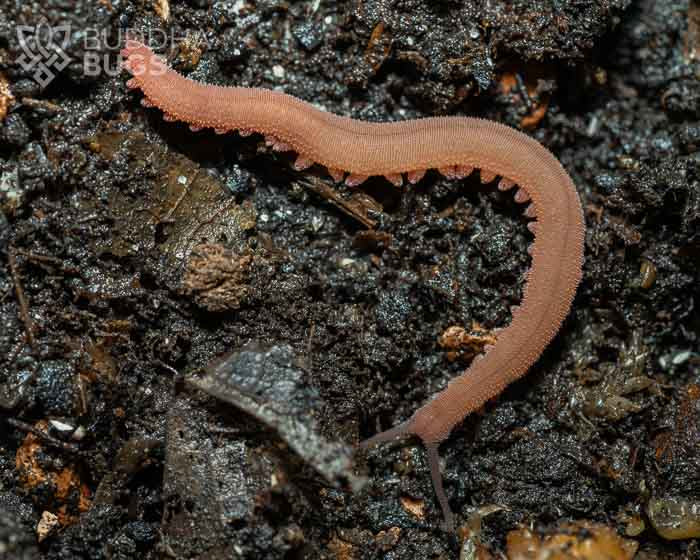
Epiperipatus barbadensis, commonly known as the Barbados brown velvet worm, is a medium-sized peripatid onychophoran known only from the Caribbean island of Barbados. Despite its common name, it is not a true worm but a member of the distinct phylum Onychophora. Adults have a soft, highly flexible body with numerous pairs of unjointed lobopod legs, each ending in two small claws. The females examined in the original species description possessed 31 pairs of legs. The dorsal surface ranges from reddish-brown to dark chocolate-brown and may display a fine, pale middorsal line, while the underside is lighter. Dense microscopic scales and sensory papillae give the finely folded cuticle its characteristic velvety appearance. Large individuals may reach approximately 3–3.5 inches when fully extended, although the body contracts to a fraction of that length at rest.
In captivity, E. barbadensis is strongly photophobic and almost entirely nocturnal. Individuals remain compressed together within damp, narrow retreats during the day and emerge after dark to forage. When prey is encountered, the paired oral papillae eject rapidly oscillating streams of protein-rich adhesive slime, weaving a sticky net that entangles the prey before the velvet worm begins feeding. This species tolerates conspecifics and can be maintained in groups when sufficient food and shelter are available. It is viviparous: females retain and nourish developing embryos internally before giving birth to fully formed young. The species was described entirely from females, and no male has subsequently been formally described. It therefore remains unresolved whether males occur or whether E. barbadensis may reproduce parthenogenetically, as has been documented in Epiperipatus imthurni. Although E. barbadensis is among the more successfully established velvet worms in captivity, it remains a specialized animal that is considerably less forgiving of desiccation, stagnant water, accumulated waste, and environmental contaminants than most commonly kept invertebrates. We have maintained and reproduced this species continuously since 2021, and the guidance below reflects that long-term firsthand experience.
- Common Name: Barbados brown velvet worm
- Native Range: Barbados
- Life Habit: Terrestrial, nocturnal inhabitant of leaf litter and decomposing wood
- Adult Size: Approximately 3–3.5 inches when fully extended
- Lifespan: Several years in captivity; exact maximum remains unknown
- Temperament: Secretive, strongly photophobic, and tolerant of conspecifics
- Care Difficulty: Moderate; requires stable moisture, careful sanitation, and strict contaminant control
Epiperipatus barbadensis Care
Epiperipatus barbadensis can thrive and reproduce in several types of enclosures, ranging from simple containers filled with long-fiber sphagnum moss to planted bioactive setups with soil, leaf litter, and cork bark retreats. Regardless of the design, conditions must remain consistently humid without becoming saturated, stagnant, or foul. Monitor the setup closely, as this species can decline rapidly once environmental conditions deteriorate.
Velvet worms possess a thin, flexible cuticle and numerous tracheal openings that lack a closing mechanism, leaving them vulnerable to rapid water loss. Their delicate exterior also makes direct contact and exposure to residues unnecessarily risky. Use distilled water—and only distilled water—for every part of the setup and routine husbandry. Avoid fertilizers, pesticides, cleaning products, fragrances, lotions, nicotine, and other possible contaminants. Do not handle these animals directly. Before reaching into the enclosure, wash your hands with mild, unscented soap, rinse thoroughly, dry completely, and use clean tools whenever possible.
- Enclosure: Use a secure, moisture-retaining enclosure sized appropriately for the number and size of the animals. Upgrade it as needed when the animals grow or the population increases. Provide limited ventilation that allows air exchange without letting the setup dry out too quickly. Keep the ventilation openings unobstructed rather than completely sealed or covered. Ensure that the lid and every opening are escape-proof; velvet worms can compress their bodies and pass through surprisingly narrow gaps.
- Substrate: Long-fiber sphagnum moss, coconut fiber, peat moss, topsoil, or a mixture of moisture-retentive materials can work well. All materials should be pesticide- and fertilizer-free and obtained from a trusted source. The substrate should remain consistently moist but loose and aerated, not saturated or swampy. Cork bark, decomposing hardwood, leaf litter, and additional sphagnum may be arranged to create narrow, dark retreats. We maintain our colony entirely on long-fiber sphagnum moss because this simple setup is easy to inspect and replace, but soil-based setups with cork bark retreats can also support long-term cultures when maintained appropriately.
- Temperature: 72–82°F.
- Humidity: High ambient humidity is essential. Keep the full substrate surface consistently moist while preventing pooling water, persistent saturation, or foul anaerobic conditions. The enclosure should retain humidity without becoming stagnant.
- Diet: Appropriately sized captive-produced crickets, cockroaches, and other clean, pesticide-free feeder insects. Never use wild-caught prey. Offer smaller prey to groups containing newborns or young juveniles.
- Feeding: Offer prey approximately once weekly, adjusting the number and size according to the group and the amount consumed. Velvet worms often leave an emptied prey carcass and adhesive residue behind. Inspect the enclosure after feeding and remove all remains promptly.
- Water: Moisten the substrate, sphagnum, and enclosure surfaces with distilled water only. Do not use tap, spring, filtered, or conditioned water.
- Routine Maintenance: Remove prey remains and visible waste as soon as possible, monitor for mold, mites, or excessive populations of other microfauna, and spot-clean with minimal disruption. The need for substrate replacement depends on enclosure size, population, and design. In our sphagnum-only setups, we completely replace all moss approximately every two weeks to several months, with smaller or more densely populated enclosures generally requiring more frequent replacement. Soil-based and bioactive setups may require different maintenance schedules. Do not use household cleaners or disinfectants inside the enclosure.
Natural History
Claudio G. Froehlich originally described the Barbados population in 1962 as the subspecies Peripatus dominicae barbadensis. The description was based on three females collected by Reverend E. J. Pearce from the grounds of Codrington College in the parish of Saint John, Barbados, during August and September 1960. The holotype was found in leaf mold. All three specimens possessed 31 pairs of legs, as did two advanced embryos discovered within the paired uteri of the largest female. Those embryos were already approximately 20 mm long, demonstrating the advanced stage reached before birth. The preserved type specimens measured only 17–32 mm, but body-length measurements in onychophorans vary dramatically with contraction, preservation, and the method used; living adults can extend considerably farther. No male was included in the original series, and none has since been formally described. Reproduction in captive cultures does not by itself establish sexual reproduction, so the presence of males and the possibility of parthenogenesis both remain unresolved.
The original collector reported finding the animal at two localities several miles apart and expressed surprise that it persisted through Barbados’s frequent dry periods. Its survival depends on humid microhabitats within leaf litter, decomposing wood, soil cavities, and other sheltered spaces that remain buffered from surface conditions. This dependence, combined with nocturnal activity and prolonged daytime concealment, makes the species easy to overlook and leaves its current distribution on the island incompletely documented.
V. Morley St. J. Read transferred the taxon to Epiperipatus and treated it as the distinct species Epiperipatus barbadensis in 1988. That name remains accepted, but the modern world checklist of Onychophora notes that the available museum material is poorly suited to contemporary analysis and that the species still requires detailed morphological revision and molecular characterization. Froehlich also considered its presence on Barbados biogeographically unusual because the island is geologically young and has never had a recent land connection to the neighboring Lesser Antilles. He proposed either over-water dispersal or human-assisted transport as possible explanations. The species is presently known only from Barbados, but the origin and age of that island population remain unresolved.
The adhesive slime of E. barbadensis has also become a subject of modern biochemical research. Its large slime proteins contain unusual phosphonate modifications, and the mechanically formed adhesive fibers produced by velvet worms can dissolve in water and be regenerated. These properties have made onychophoran slime a useful natural model for developing recyclable protein-based fibers, adhesives, and other materials.
Shipping
Shipping
Shipping method for live animal orders:
Orders containing live animals must have a subtotal of at least $50 to qualify for shipping.
For orders containing live animals, we ship throughout the continental U.S. (48 states) via FedEx Priority Overnight. Orders containing both live and non-live products may be shipped together or separately, depending on the items in the order, their sizes, and whether everything can fit safely in one shipment. When non-live products must be shipped separately by USPS, additional shipping charges will apply.
Live-animal packages are normally dropped off on Tuesdays or Wednesdays for next-day arrival. By default, packages are held for pickup at the nearest reasonably accessible FedEx Ship Center authorized to accept the shipment and must be collected in person.
Home delivery is available upon request. When a reasonably accessible authorized FedEx Ship Center is available, customer-requested home delivery is not eligible for our live arrival guarantee and is sent at the customer’s risk.
FedEx Ship Center availability varies by destination, and not every FedEx location is authorized to accept live-animal shipments. If no reasonably accessible authorized FedEx Ship Center is available, we will contact the customer and arrange home delivery. In this circumstance, home delivery remains eligible for LAG, provided all other LAG requirements are met.
Checkout shipping rates and free-shipping offers are based on FedEx Ship Center pickup. Any additional amount charged for home delivery is the customer’s responsibility and must be paid before shipment. For qualifying orders, free shipping covers standard Ship Center service but not any additional home-delivery cost. If no reasonably accessible authorized Ship Center is available and the customer declines the additional charge, the affected portion of the order—or the entire order when necessary—may be canceled without the standard cancellation fee.
We also offer expo pickup and a DFW local-meetup option. Please see our Expo Schedule for additional information.
Shipping method for non-live orders:
For shipments containing no live animals, shipping is available to all 50 states via USPS Ground Advantage or USPS Priority Mail. We will ship non-live orders directly to the address listed on the order, typically the day the order is placed or the following day.
What to expect after placing an order:
If your order contains live animals that will be shipped, we will contact you within 12 hours with a proposed delivery date and, when applicable, the FedEx Ship Center pickup location. If home delivery is requested or required, we will provide the delivery arrangements and any additional shipping charge. We will not ship the package until you confirm the arrangements and any outstanding shipping balance has been paid. Tracking information will be provided on the day of shipment.
Shipping may be delayed because of weather, carrier conditions, our schedule, or if an animal has recently molted or appears likely to molt. We will notify you if a delay is necessary and arrange another suitable date.
Carrier delays can occur. Customers remain responsible for meeting the applicable pickup or receipt requirements on the day the package actually arrives, even if it arrives later than originally scheduled.
Live Arrival Guarantee (LAG):
Buddha Bugs offers a live arrival guarantee only when all of the following conditions are met:
- Freebies are not covered by LAG.
- When a reasonably accessible FedEx Ship Center authorized to accept the shipment is available, the package must be held for pickup at that location.
- If no such location is available, we will arrange home delivery. In this circumstance, home delivery remains eligible for LAG, provided all other requirements are met.
- Packages held at a FedEx Ship Center must be picked up on the day they arrive. Pickup at any time during the location’s regular opening hours is acceptable. Please bring valid identification.
- In the unlikely event of a DOA, the customer must contact us and provide clear photographic or video evidence within three hours of FedEx Ship Center pickup—or within three hours of delivery when an LAG-eligible home delivery applies.
- Shipping costs are not refunded, and replacements may not always be available.
ANY DEVIATION FROM THESE REQUIREMENTS MAY VOID THE LAG.
Home delivery is available upon request. When a reasonably accessible FedEx Ship Center authorized to accept the shipment is available, customer-requested home delivery is not eligible for LAG and is sent at the customer’s risk. When no such location is available, home delivery arranged by Buddha Bugs is eligible for LAG, provided all other requirements are met.
For animal safety, we do not ship live animals for home delivery when temperatures are 90°F or higher or 35°F or lower, regardless of whether the shipment would otherwise qualify for LAG.
FedEx does not reimburse Buddha Bugs for lost packages or the loss of live animals. We take every reasonable precaution to give each shipment the best chance of arriving safely.
Returns & Refunds
Returns & Refunds
Returns & Refunds:
We DO NOT accept returns on live animals.
You may return non-live animal products for a refund within 14 days of delivery. The product must be unused and in its original packaging. After we receive your return, we will process refunds within 5-10 business days. Refunds will not include shipping costs. We will reject used products and, when possible, ship them back to the customer.
If an animal arrives deceased, contact us within the required three-hour period and provide clear photographic or video evidence. When all live arrival guarantee requirements are met, we will provide the applicable refund or arrange a replacement when available. Multi-count products are handled according to the number of live animals received. Shipping costs and freebies are not covered. Please review our Shipping & Live Arrival Policy for complete requirements.
For online purchases with local pickup, pickup at a show, or for purchases made at a show, the customer is responsible for inspecting the purchased items and verifying that they are to their satisfaction. If they are not, they must express any dissatisfaction before the sale is completed, as all sales are final. We are not liable for damages after the customer receives their items due to issues including but not limited to the customer mishandling transport and/or overheating animals.
Cancellations:
Customer-requested cancellations are subject to an approximately 3% cancellation fee. For card payments, the fee is 2.9% + $0.30 per transaction; different payment methods may have slightly higher or lower fee amounts. This reflects the nonrecoverable payment-processing cost charged when the order is placed and not returned to us when a refund is issued. Canceling an order also creates additional labor and temporarily removes inventory from availability, so please make sure you are committed before placing an order.
If a product is unavailable because of an inventory error, we will contact the customer and offer to cancel the affected product or the complete order without a cancellation fee.
If we determine after an order is placed that no reasonably accessible FedEx Ship Center authorized to accept the shipment is available, we will contact the customer with any additional cost required for home delivery. If the customer declines that additional charge, the affected portion of the order—or the entire order when necessary—may be canceled without the standard cancellation fee.
Certain ESA-listed Poecilotheria species cannot be shipped across state lines and are clearly marked “TX SALES ONLY” in their product titles and descriptions. If a customer outside Texas purchases one of these animals, the restricted portion of the order—or the entire order when necessary—will be canceled. The approximately 3% cancellation fee will be deducted from the refund because the restriction was disclosed before purchase. Refunds will be issued to the original payment method, but the time required for the credit to appear depends on the payment provider.
Share
- 5 stars: 1 (100%)
- 4 stars: 0 (0%)
- 3 stars: 0 (0%)
- 2 stars: 0 (0%)
- 1 star: 0 (0%)
The velvet worms were boxed well! They were healthy looks awesome! Will buy from them again!!