
Buddha Bugs
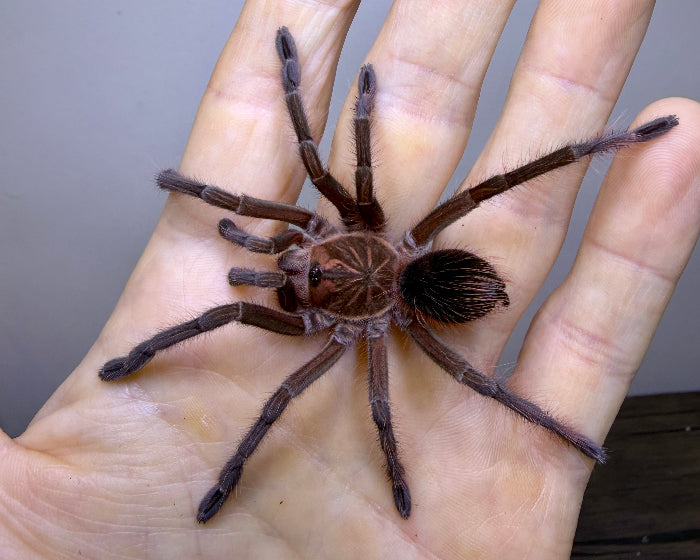
Pamphobeteus sp. ‘platyomma’ (Ecuadorian pink bloom tarantula) 0.75"
Pamphobeteus sp. ‘platyomma’ (Ecuadorian pink bloom tarantula) 0.75"
Before ordering: Unless marked “exact animal pictured,” photos are representative; refer to the product title or selected option for the size or sex offered. Shipped live-animal orders require a $50 cart subtotal and are normally held for pickup at an authorized FedEx Ship Center. Please review our Shipping & Live Arrival and Refund & Cancellation policies before purchasing.
Couldn't load pickup availability
Species Overview
Pamphobeteus sp. ‘platyomma’, referred to here as the Ecuadorian pink bloom tarantula, is a large terrestrial tarantula of unresolved species identity that may represent an undescribed species. Long-established captive stock circulated under this label is reported to originate from Ecuador. No evidence links that stock to Brazil, despite the geographically inaccurate common name “Brazilian pink bloom tarantula,” which is still frequently applied within the hobby. Spiderlings have a salmon-pink to reddish-orange carapace with a dark central field and broad dark markings along the radiating grooves. The legs transition from pinkish gray or muted violet proximally to slate-gray or blue-black distally. The abdomen is vivid orange-red with a broad black median field, branching lateral extensions, and dark transverse bands that produce the familiar “Christmas tree” pattern. This contrast fades with growth. Subadults have a reddish-brown to dark chocolate-brown carapace with narrow paler radiating lines, dark brown to purplish-gray legs, and an unpatterned dark abdomen clothed in long pale gray or muted copper-colored hairs.
The sexes remain broadly similar until the male’s maturing molt. Adult females are large and robust, with a smoky gray-brown to charcoal-black carapace and predominantly brown to black legs. The patellae and tibiae may display muted dark brown, reddish-brown, or copper-brown areas, while pale gray setae form narrow fringes around many of the segment margins. The abdomen is deep brown to nearly black and covered with longer gray hairs. Mature males are slimmer and proportionally longer-legged and develop alternating charcoal-black and vivid rose-pink fields across the carapace, producing a sharply defined starburst pattern. Similarly bright fields cover the femora, patellae, much of the tibiae, and the pedipalps, contrasting with the dark metatarsi, tarsi, and abdomen. Depending on the lighting, the pink coloration may shift toward crimson, magenta, or violet.
In captivity, P. sp. ‘platyomma’ grows rapidly, feeds readily, and commonly excavates beneath cork bark or enlarges a provided starter retreat. Spiderlings and smaller juveniles may spend considerable time below the surface, while larger specimens frequently remain visible at or near the retreat entrance, particularly after dark or when hunting. Individuals generally attempt to retreat when disturbed but can move quickly, readily release urticating hairs, and may occasionally assume a defensive posture. Although its environmental requirements are relatively straightforward, its eventual size, speed, strong feeding response, and irritating urticating hairs make deliberate maintenance practices important.
- Hobby Name: Ecuadorian pink bloom tarantula
- Derivative Range: Ecuador; precise collection locality unresolved
- Life Habit: Terrestrial opportunistic burrower
- Adult Size: 8–9 inches in diagonal leg span
- Lifespan: Males approximately 3–5 years; females 12–15+ years under optimal conditions
- Temperament: Skittish; readily flicks urticating hairs and may be defensive
- Care Difficulty: Easy to Moderate
Pamphobeteus sp. ‘platyomma’ Care
Pamphobeteus sp. ‘platyomma’ adapts well to captivity when maintained in a secure, well-ventilated enclosure with generous floor space, deep substrate, and a stable moisture gradient. Its rapid growth requires regular enclosure upgrades, and the enclosure for larger specimens should keep climbing height low to reduce the risk of injury from a fall. The substrate should retain some moisture below the surface without remaining uniformly wet or waterlogged.
- Enclosure: 2.5” cube or similar for spiderlings, upgraded as needed with growth; 18” x 18” x 12” or equivalent for adults
- Substrate: Provide sufficient depth of moisture-retentive substrate to accommodate excavation and minimize vertical fall distance. Coconut fiber, peat moss, topsoil, and similar substrates work well. Cork bark or similar enclosure décor can be partially buried to provide a starter retreat.
- Temperature: 72–82°F.
- Humidity: Moderate ambient humidity is generally sufficient. Approximately 50% of the substrate should retain moisture to provide a humidity gradient while allowing the remainder and the exposed surface to dry. Avoid saturated substrate, persistent condensation, and poorly ventilated conditions.
- Diet: Crickets, cockroaches, and other appropriately sized feeder insects.
- Feeding: Spiderlings can be offered appropriately sized prey once or twice weekly. Juveniles and adults are typically fed every 7–14 days, with feeding frequency adjusted according to prey size, growth rate, and the condition of the individual tarantula.
- Water: Moisten part of the substrate as needed and provide water droplets on enclosure surfaces and webbing for spiderlings; larger specimens should have access to a water dish.
- Routine Maintenance: Remove uneaten prey, monitor moisture levels, and spot-clean when necessary.
Natural History
The label “platyomma” has a complicated history and does not represent a valid species identification for the Ecuadorian tarantula maintained under this name. Cândido Firmino de Mello-Leitão described Pamphobeteus platyomma in 1923 from Brazilian material. Sylvia Lucas, Pedro Ismael da Silva Junior, and Rogério Bertani transferred that species to the Brazilian genus Vitalius in 1993. Subsequent examination determined that its holotype was an immature male lacking the adult characteristics required for reliable identification, and Vitalius platyomma was treated as a nomen dubium by Bertani in 2001.
The Ecuadorian captive stock has circulated under the informal designation Pamphobeteus sp. ‘platyomma’, despite having no demonstrated connection to the Brazilian type specimen. The long-used common name “Brazilian pink bloom tarantula” resulted from this taxonomic misapplication rather than from any documented Brazilian origin. No evidence links the captive stock to Brazil, making Ecuadorian pink bloom tarantula the more geographically appropriate common name. The abbreviation “sp.” and quotation marks around ‘platyomma’ are important because they indicate that the word is an informal lineage label rather than a formally published species epithet.
Some hobby accounts place the original stock in northwestern Ecuador, but a precise collection locality supported by published voucher information has not been established. Ecuador supports numerous superficially similar Pamphobeteus species, and several have been formally described during recent taxonomic work. However, no published study has yet compared the captive lineage sold as P. sp. ‘platyomma’ with suitable type material and securely documented specimens. Its orange-and-black spiderling pattern, dark adult females, and brightly iridescent mature males are shared in varying forms by multiple Ecuadorian members of the genus and are not independently diagnostic.
Decades of inconsistent labeling within the hobby further complicate the problem. Because many Ecuadorian Pamphobeteus are difficult to distinguish without adult reproductive morphology and reliable locality data, specimens circulated under different informal names may have been confused, combined, or incorrectly identified. Hybridization has therefore likely occurred among several captive hobby lineages, making it even more difficult to connect some existing stock with formally described species. This does not mean that every specimen or lineage is hybridized, but informal hobby names should not be interpreted as proof of taxonomic identity or genetically distinct wild populations. The lineage sold as P. sp. ‘platyomma’ should therefore continue to be maintained under its established informal label rather than assigned to a described species or deliberately combined with other Ecuadorian hobby forms based only on appearance.
Published field observations cannot presently be attributed specifically to this lineage because its precise identity and collection locality remain unresolved. Its behavior in captivity indicates a terrestrial, opportunistically burrowing life habit. Individuals excavate beneath solid objects, reinforce their retreats with silk, and wait near the entrance to detect passing prey through vibrations. In captivity, activity is greatest after dark, while daylight hours are generally spent inside or near the retreat. Husbandry recommendations for the lineage are consequently based primarily on its long captive history rather than on assumptions about a particular Ecuadorian habitat.
Shipping
Shipping
Shipping method for live animal orders:
Orders containing live animals must have a subtotal of at least $50 to qualify for shipping.
For orders containing live animals, we ship throughout the continental U.S. (48 states) via FedEx Priority Overnight. Orders containing both live and non-live products may be shipped together or separately, depending on the items in the order, their sizes, and whether everything can fit safely in one shipment. When non-live products must be shipped separately by USPS, additional shipping charges will apply.
Live-animal packages are normally dropped off on Tuesdays or Wednesdays for next-day arrival. By default, packages are held for pickup at the nearest reasonably accessible FedEx Ship Center authorized to accept the shipment and must be collected in person.
Home delivery is available upon request. When a reasonably accessible authorized FedEx Ship Center is available, customer-requested home delivery is not eligible for our live arrival guarantee and is sent at the customer’s risk.
FedEx Ship Center availability varies by destination, and not every FedEx location is authorized to accept live-animal shipments. If no reasonably accessible authorized FedEx Ship Center is available, we will contact the customer and arrange home delivery. In this circumstance, home delivery remains eligible for LAG, provided all other LAG requirements are met.
Checkout shipping rates and free-shipping offers are based on FedEx Ship Center pickup. Any additional amount charged for home delivery is the customer’s responsibility and must be paid before shipment. For qualifying orders, free shipping covers standard Ship Center service but not any additional home-delivery cost. If no reasonably accessible authorized Ship Center is available and the customer declines the additional charge, the affected portion of the order—or the entire order when necessary—may be canceled without the standard cancellation fee.
We also offer expo pickup and a DFW local-meetup option. Please see our Expo Schedule for additional information.
Shipping method for non-live orders:
For shipments containing no live animals, shipping is available to all 50 states via USPS Ground Advantage or USPS Priority Mail. We will ship non-live orders directly to the address listed on the order, typically the day the order is placed or the following day.
What to expect after placing an order:
If your order contains live animals that will be shipped, we will contact you within 12 hours with a proposed delivery date and, when applicable, the FedEx Ship Center pickup location. If home delivery is requested or required, we will provide the delivery arrangements and any additional shipping charge. We will not ship the package until you confirm the arrangements and any outstanding shipping balance has been paid. Tracking information will be provided on the day of shipment.
Shipping may be delayed because of weather, carrier conditions, our schedule, or if an animal has recently molted or appears likely to molt. We will notify you if a delay is necessary and arrange another suitable date.
Carrier delays can occur. Customers remain responsible for meeting the applicable pickup or receipt requirements on the day the package actually arrives, even if it arrives later than originally scheduled.
Live Arrival Guarantee (LAG):
Buddha Bugs offers a live arrival guarantee only when all of the following conditions are met:
- Freebies are not covered by LAG.
- When a reasonably accessible FedEx Ship Center authorized to accept the shipment is available, the package must be held for pickup at that location.
- If no such location is available, we will arrange home delivery. In this circumstance, home delivery remains eligible for LAG, provided all other requirements are met.
- Packages held at a FedEx Ship Center must be picked up on the day they arrive. Pickup at any time during the location’s regular opening hours is acceptable. Please bring valid identification.
- In the unlikely event of a DOA, the customer must contact us and provide clear photographic or video evidence within three hours of FedEx Ship Center pickup—or within three hours of delivery when an LAG-eligible home delivery applies.
- Shipping costs are not refunded, and replacements may not always be available.
ANY DEVIATION FROM THESE REQUIREMENTS MAY VOID THE LAG.
Home delivery is available upon request. When a reasonably accessible FedEx Ship Center authorized to accept the shipment is available, customer-requested home delivery is not eligible for LAG and is sent at the customer’s risk. When no such location is available, home delivery arranged by Buddha Bugs is eligible for LAG, provided all other requirements are met.
For animal safety, we do not ship live animals for home delivery when temperatures are 90°F or higher or 35°F or lower, regardless of whether the shipment would otherwise qualify for LAG.
FedEx does not reimburse Buddha Bugs for lost packages or the loss of live animals. We take every reasonable precaution to give each shipment the best chance of arriving safely.
Returns & Refunds
Returns & Refunds
Returns & Refunds:
We DO NOT accept returns on live animals.
You may return non-live animal products for a refund within 14 days of delivery. The product must be unused and in its original packaging. After we receive your return, we will process refunds within 5-10 business days. Refunds will not include shipping costs. We will reject used products and, when possible, ship them back to the customer.
If an animal arrives deceased, contact us within the required three-hour period and provide clear photographic or video evidence. When all live arrival guarantee requirements are met, we will provide the applicable refund or arrange a replacement when available. Multi-count products are handled according to the number of live animals received. Shipping costs and freebies are not covered. Please review our Shipping & Live Arrival Policy for complete requirements.
For online purchases with local pickup, pickup at a show, or for purchases made at a show, the customer is responsible for inspecting the purchased items and verifying that they are to their satisfaction. If they are not, they must express any dissatisfaction before the sale is completed, as all sales are final. We are not liable for damages after the customer receives their items due to issues including but not limited to the customer mishandling transport and/or overheating animals.
Cancellations:
Customer-requested cancellations are subject to an approximately 3% cancellation fee. For card payments, the fee is 2.9% + $0.30 per transaction; different payment methods may have slightly higher or lower fee amounts. This reflects the nonrecoverable payment-processing cost charged when the order is placed and not returned to us when a refund is issued. Canceling an order also creates additional labor and temporarily removes inventory from availability, so please make sure you are committed before placing an order.
If a product is unavailable because of an inventory error, we will contact the customer and offer to cancel the affected product or the complete order without a cancellation fee.
If we determine after an order is placed that no reasonably accessible FedEx Ship Center authorized to accept the shipment is available, we will contact the customer with any additional cost required for home delivery. If the customer declines that additional charge, the affected portion of the order—or the entire order when necessary—may be canceled without the standard cancellation fee.
Certain ESA-listed Poecilotheria species cannot be shipped across state lines and are clearly marked “TX SALES ONLY” in their product titles and descriptions. If a customer outside Texas purchases one of these animals, the restricted portion of the order—or the entire order when necessary—will be canceled. The approximately 3% cancellation fee will be deducted from the refund because the restriction was disclosed before purchase. Refunds will be issued to the original payment method, but the time required for the credit to appear depends on the payment provider.
Share