

Buddha Bugs
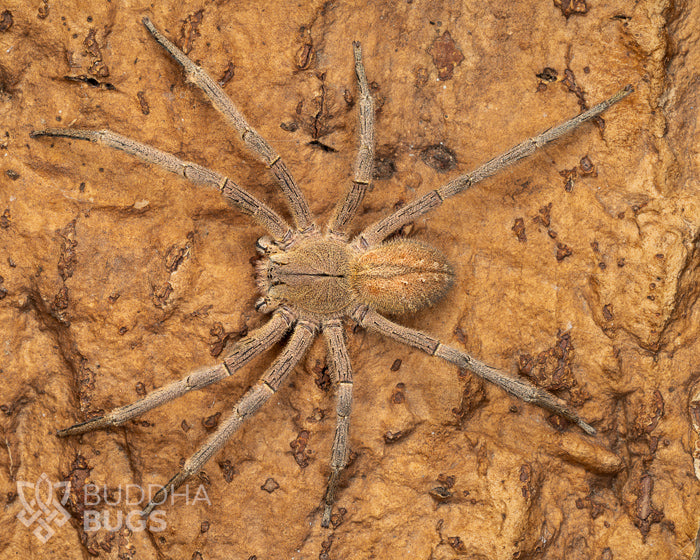
Phoneutria depilata (depilated wandering spider) 0.75"
Phoneutria depilata (depilated wandering spider) 0.75"
Before ordering: Unless marked “exact animal pictured,” photos are representative; refer to the product title or selected option for the size or sex offered. Shipped live-animal orders require a $50 cart subtotal and are normally held for pickup at an authorized FedEx Ship Center. Please review our Shipping & Live Arrival and Refund & Cancellation policies before purchasing.
Couldn't load pickup availability
Species Overview
Phoneutria depilata, referred to here as the depilated wandering spider, is a large wandering spider native to Central America and northwestern South America. We coined this common name from the species epithet. Within the hobby, the species is frequently mislabeled and sold as Phoneutria fera and marketed under the geographically inaccurate common name “Brazilian wandering spider.” Broader labels such as Central American wandering spider, Panama wandering spider, and banana spider are also applied to this species, but none is specific to it; we therefore use depilated wandering spider as the primary common name.
Mature specimens and larger juveniles range from yellowish-brown and warm reddish-brown to darker gray-brown, with a narrow black longitudinal line extending along the carapace. The abdomen is mottled yellow-brown to dark brown and may display paired pale spots or broken longitudinal markings, while the long legs are variably mottled or banded. Mature males are smaller-bodied and proportionally longer-legged than females. The front-facing portions of the chelicerae generally match the spider’s surrounding coloration, while their undersides are dark brown to black. Pale tan to copper-colored setae line the lower and inner surfaces, but the species lacks the conspicuous red cheliceral covering seen in P. nigriventer. The ventral abdomen bears a distinctive dark brown central field containing four broken longitudinal series of cream-to-pale yellow spots that may merge into short, elongated bars. Ventral abdominal patterning is among the most useful external features for distinguishing species within Phoneutria, although reliable identification should consider this pattern together with the complete morphology and geographic origin.
In captivity, P. depilata is primarily nocturnal and readily uses both ground-level and elevated positions. Individuals often rest in narrow, dark retreats during the day before emerging to hunt at night. It does not construct a prey-capture web, although it deposits silk while moving and may wrap captured prey before securing it to the substrate. When disturbed, an individual may retreat rapidly or assume the characteristic Phoneutria defensive posture by raising the anterior legs, exposing the chelicerae and fangs, and moving laterally. The species is fast, can strike when confined, and possesses medically significant venom. Documented bites have caused intense pain, swelling, and systemic effects, with severe envenomation reported in at least one published case. Any suspected bite requires immediate emergency medical evaluation.
- Common Name: Depilated wandering spider
- Native Range: Guatemala, Honduras, Nicaragua, Costa Rica, Panama, Colombia, and Ecuador
- Life Habit: Terrestrial/semi-arboreal wandering hunter
- Adult Size: 4–5.5 inches in diagonal leg span
- Lifespan: Males 1–2 years; females 2–3+ years under optimal conditions
- Temperament: Fast and readily defensive when confined or disturbed
- Care Difficulty: Easy to moderate; strict containment and cautious maintenance required due to medically significant venom
Phoneutria depilata Care
Phoneutria depilata adapts well to captivity when maintained in a secure, well-ventilated enclosure that provides sufficient floor space, usable height, retreats at multiple levels, and a stable moisture gradient. The setup should never be allowed to dry completely, as small spiderlings and recently molted individuals appear especially susceptible to desiccation. Although its environmental requirements are straightforward, its speed, defensive behavior, and medically significant venom require careful containment and deliberate maintenance practices. Long tools should be used during all maintenance and rehousing, and a secure catch cup should be kept within immediate reach. Whenever possible, these procedures should be performed inside a larger secondary container that can hold the spider if it escapes the primary enclosure.
- Enclosure: 7-dram vial or equivalent for spiderlings, upgraded as needed with growth; 12” cube or larger for adults. Use a tightly locking lid and ensure ventilation openings are small enough to prevent escape.
- Substrate: Coconut fiber, peat moss, topsoil, or a similar moisture-retentive substrate; add leaf litter, curved or vertically oriented cork bark, branches, broad-leaved live or artificial plants, and overlapping décor that creates narrow retreats both near the substrate and in elevated positions.
- Temperature: 72–82°F.
- Humidity: Maintain moderate to high humidity with a moisture gradient by keeping approximately 50% of the substrate moist while allowing the remainder to stay comparatively drier. Never allow the entire setup to dry out. Small spiderlings and recently molted individuals should be monitored especially closely because they appear particularly susceptible to desiccation. Provide enough cross-ventilation to prevent stagnant conditions without allowing the enclosure to dry rapidly, and never keep the substrate saturated or waterlogged.
- Diet: Fruit flies, crickets, cockroaches, and other appropriately sized feeder insects.
- Feeding: Spiderlings can be offered appropriately sized prey once or twice weekly. Juveniles and adults are typically fed every 7–14 days, with feeding frequency adjusted based on prey size, growth rate, and the condition of the individual animal.
- Water: Regularly apply droplets to the side of the enclosure for small spiderlings, keeping drinking water available without excessively saturating the setup. Small spiderling containers can dry rapidly and should be checked frequently, particularly during and shortly after a molt. Larger specimens should have access to a water dish.
- Routine Maintenance: Remove uneaten prey, monitor moisture levels, and spot-clean when necessary.
Natural History
Phoneutria depilata was described in 1909 but was later treated as a synonym of Phoneutria boliviensis. In 2021, an integrative study using morphology, molecular evidence, distribution data, and ecological modeling revalidated P. depilata as a distinct species. Many older publications concerning Central American and trans-Andean Colombian populations under the name P. boliviensis therefore refer to P. depilata. True P. boliviensis is an Amazonian species occurring east of the Andes, whereas P. depilata occupies the trans-Andean region west of the mountain range and extends northward through Central America.
Under the current taxonomy, P. depilata occurs from Guatemala south through Central America into trans-Andean Colombia and Ecuador, from sea level to approximately 1,700 meters. It inhabits both humid and seasonally dry tropical environments and shows considerable tolerance for disturbed habitats. Field studies indicate flexible microhabitat use rather than a strictly terrestrial habit. In Colombia, most observed individuals were on the ground among sparse leaf litter, while others were on low vegetation. Research on Costa Rican populations—published under the name P. boliviensis before the revalidation of P. depilata—instead found these spiders strongly associated with vegetation within and around treeless swamp habitat. Taken together, these observations support a terrestrial/semi-arboreal classification: the species is not an arboreal canopy specialist, but it routinely uses elevated vegetation and retreats. During the day, individuals may shelter within vegetation, beneath fallen material, among building debris, and around banana plantations or human structures. This adaptability brings the species into contact with people more often than many strictly forest-dependent spiders.
Within the invertebrate hobby, a separate identification problem persists: P. depilata is frequently labeled and sold as P. fera. True P. fera is a separate Amazonian species distributed through Colombia, Ecuador, Peru, Brazil, Suriname, and Guyana, and its name should not be applied to Central American or trans-Andean P. depilata. The common name “Brazilian wandering spider” is equally inappropriate for P. depilata, which is not known from Brazil.
Shipping
Shipping
Shipping method for live animal orders:
Orders containing live animals must have a subtotal of at least $50 to qualify for shipping.
For orders containing live animals, we ship throughout the continental U.S. (48 states) via FedEx Priority Overnight. Orders containing both live and non-live products may be shipped together or separately, depending on the items in the order, their sizes, and whether everything can fit safely in one shipment. When non-live products must be shipped separately by USPS, additional shipping charges will apply.
Live-animal packages are normally dropped off on Tuesdays or Wednesdays for next-day arrival. By default, packages are held for pickup at the nearest reasonably accessible FedEx Ship Center authorized to accept the shipment and must be collected in person.
Home delivery is available upon request. When a reasonably accessible authorized FedEx Ship Center is available, customer-requested home delivery is not eligible for our live arrival guarantee and is sent at the customer’s risk.
FedEx Ship Center availability varies by destination, and not every FedEx location is authorized to accept live-animal shipments. If no reasonably accessible authorized FedEx Ship Center is available, we will contact the customer and arrange home delivery. In this circumstance, home delivery remains eligible for LAG, provided all other LAG requirements are met.
Checkout shipping rates and free-shipping offers are based on FedEx Ship Center pickup. Any additional amount charged for home delivery is the customer’s responsibility and must be paid before shipment. For qualifying orders, free shipping covers standard Ship Center service but not any additional home-delivery cost. If no reasonably accessible authorized Ship Center is available and the customer declines the additional charge, the affected portion of the order—or the entire order when necessary—may be canceled without the standard cancellation fee.
We also offer expo pickup and a DFW local-meetup option. Please see our Expo Schedule for additional information.
Shipping method for non-live orders:
For shipments containing no live animals, shipping is available to all 50 states via USPS Ground Advantage or USPS Priority Mail. We will ship non-live orders directly to the address listed on the order, typically the day the order is placed or the following day.
What to expect after placing an order:
If your order contains live animals that will be shipped, we will contact you within 12 hours with a proposed delivery date and, when applicable, the FedEx Ship Center pickup location. If home delivery is requested or required, we will provide the delivery arrangements and any additional shipping charge. We will not ship the package until you confirm the arrangements and any outstanding shipping balance has been paid. Tracking information will be provided on the day of shipment.
Shipping may be delayed because of weather, carrier conditions, our schedule, or if an animal has recently molted or appears likely to molt. We will notify you if a delay is necessary and arrange another suitable date.
Carrier delays can occur. Customers remain responsible for meeting the applicable pickup or receipt requirements on the day the package actually arrives, even if it arrives later than originally scheduled.
Live Arrival Guarantee (LAG):
Buddha Bugs offers a live arrival guarantee only when all of the following conditions are met:
- Freebies are not covered by LAG.
- When a reasonably accessible FedEx Ship Center authorized to accept the shipment is available, the package must be held for pickup at that location.
- If no such location is available, we will arrange home delivery. In this circumstance, home delivery remains eligible for LAG, provided all other requirements are met.
- Packages held at a FedEx Ship Center must be picked up on the day they arrive. Pickup at any time during the location’s regular opening hours is acceptable. Please bring valid identification.
- In the unlikely event of a DOA, the customer must contact us and provide clear photographic or video evidence within three hours of FedEx Ship Center pickup—or within three hours of delivery when an LAG-eligible home delivery applies.
- Shipping costs are not refunded, and replacements may not always be available.
ANY DEVIATION FROM THESE REQUIREMENTS MAY VOID THE LAG.
Home delivery is available upon request. When a reasonably accessible FedEx Ship Center authorized to accept the shipment is available, customer-requested home delivery is not eligible for LAG and is sent at the customer’s risk. When no such location is available, home delivery arranged by Buddha Bugs is eligible for LAG, provided all other requirements are met.
For animal safety, we do not ship live animals for home delivery when temperatures are 90°F or higher or 35°F or lower, regardless of whether the shipment would otherwise qualify for LAG.
FedEx does not reimburse Buddha Bugs for lost packages or the loss of live animals. We take every reasonable precaution to give each shipment the best chance of arriving safely.
Returns & Refunds
Returns & Refunds
Returns & Refunds:
We DO NOT accept returns on live animals.
You may return non-live animal products for a refund within 14 days of delivery. The product must be unused and in its original packaging. After we receive your return, we will process refunds within 5-10 business days. Refunds will not include shipping costs. We will reject used products and, when possible, ship them back to the customer.
If an animal arrives deceased, contact us within the required three-hour period and provide clear photographic or video evidence. When all live arrival guarantee requirements are met, we will provide the applicable refund or arrange a replacement when available. Multi-count products are handled according to the number of live animals received. Shipping costs and freebies are not covered. Please review our Shipping & Live Arrival Policy for complete requirements.
For online purchases with local pickup, pickup at a show, or for purchases made at a show, the customer is responsible for inspecting the purchased items and verifying that they are to their satisfaction. If they are not, they must express any dissatisfaction before the sale is completed, as all sales are final. We are not liable for damages after the customer receives their items due to issues including but not limited to the customer mishandling transport and/or overheating animals.
Cancellations:
Customer-requested cancellations are subject to an approximately 3% cancellation fee. For card payments, the fee is 2.9% + $0.30 per transaction; different payment methods may have slightly higher or lower fee amounts. This reflects the nonrecoverable payment-processing cost charged when the order is placed and not returned to us when a refund is issued. Canceling an order also creates additional labor and temporarily removes inventory from availability, so please make sure you are committed before placing an order.
If a product is unavailable because of an inventory error, we will contact the customer and offer to cancel the affected product or the complete order without a cancellation fee.
If we determine after an order is placed that no reasonably accessible FedEx Ship Center authorized to accept the shipment is available, we will contact the customer with any additional cost required for home delivery. If the customer declines that additional charge, the affected portion of the order—or the entire order when necessary—may be canceled without the standard cancellation fee.
Certain ESA-listed Poecilotheria species cannot be shipped across state lines and are clearly marked “TX SALES ONLY” in their product titles and descriptions. If a customer outside Texas purchases one of these animals, the restricted portion of the order—or the entire order when necessary—will be canceled. The approximately 3% cancellation fee will be deducted from the refund because the restriction was disclosed before purchase. Refunds will be issued to the original payment method, but the time required for the credit to appear depends on the payment provider.
Share
Healthy spiders, active and ate after a day of adjustment, answered questions when called, great company!!
- 5 stars: 1 (100%)
- 4 stars: 0 (0%)
- 3 stars: 0 (0%)
- 2 stars: 0 (0%)
- 1 star: 0 (0%)
Healthy spiders, active and ate after a day of adjustment, answered questions when called, great company!!